In this article
- Forecasting the dollar is not the same as measuring exposure
- Exposure is not limited to debt
- How can that exposure be turned into a useful measure?
- The number matters, but it also needs to be interpreted
- The impact can appear in different parts of the business
- From measuring exposure to establishing a policy
- The question changes when there is clarity
When the exchange rate fluctuates, one of the first questions that arises in many companies is where the dollar might be headed. It is an understandable question, but not necessarily the most important one.
For a company that buys, sells, collects, pays, or maintains obligations in different currencies, the risk does not depend solely on getting a forecast right, but on understanding what would happen to its cash position, margins, obligations, and results if the exchange rate moves.
For that reason, before trying to anticipate the direction of the dollar, there is a more relevant question from a business perspective:
What is the company’s actual exposure, and how sensitive is it to an exchange-rate movement?
Forecasting the dollar is not the same as measuring exposure
An exchange-rate forecast and a foreign exchange exposure analysis answer different questions. When the goal is to forecast the dollar, the analysis focuses on macroeconomic variables, market flows, historical behavior, and statistical models in order to build a central scenario accompanied by a range of uncertainty.
Measuring a company’s exposure requires looking at different variables: assets, liabilities, income, expenses, currencies, maturities, and the ability to pass exchange-rate movements through to prices. While a forecast attempts to answer where the dollar might move, exposure measurement seeks to determine what happens to the company if it actually does.
The distinction matters because even an accurate forecast is insufficient if the organization does not know how much of its operation is exposed, in which direction, and for how long. A forecast provides information about the environment; measurement translates that environment into the company’s specific reality.
Exposure is not limited to debt
Associating foreign exchange exposure only with financial obligations denominated in dollars can lead to an incomplete view. Exposure can also be found in cash, accounts receivable, investments, accounts payable, revenue, imports, costs, expenses, interest, and fees.
The timing of those flows also matters. A company may receive income in one currency and incur costs in another, or collect and pay at different times. Under those conditions, an exchange-rate movement can change its cash needs or margins even when sales remain stable.
The effect, therefore, is not limited to a single balance-sheet item. It can carry through to liquidity, working capital, margins, profit, equity, indebtedness, and financial ratios. For that reason, foreign exchange exposure should be understood as a business risk, not exclusively a financial one.
How can that exposure be turned into a useful measure?
Measuring it means moving from a general concern about the exchange rate to a structured view of the company’s positions and flows. The process can be summarized in four steps:
- Identify where the exposure lies.
- Calculate the gaps.
- Integrate them.
- Simulate what would happen under different exchange-rate movements.
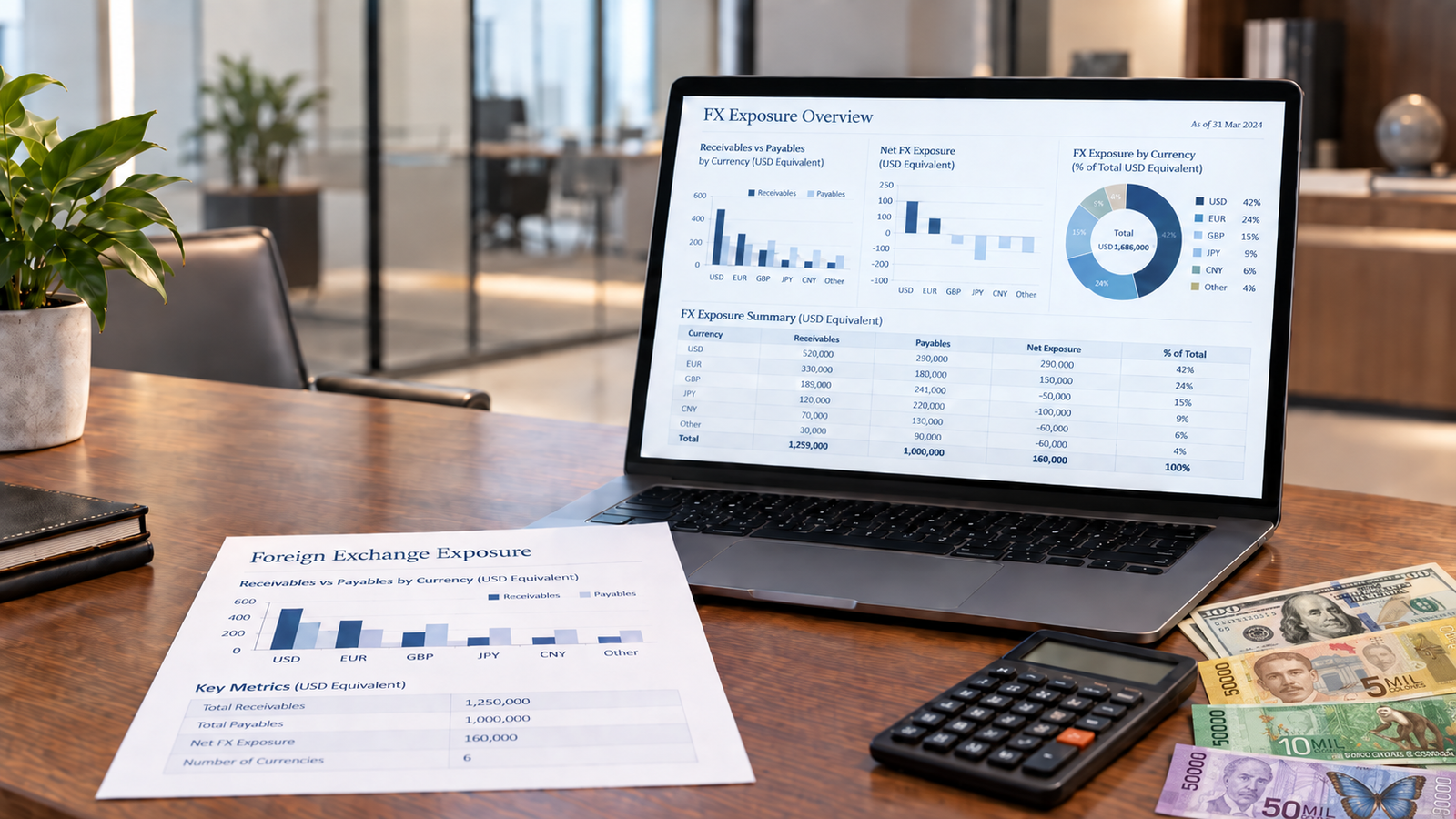
The first step is to map foreign-currency positions and flows by entity, currency, and maturity. From that information, the so-called foreign exchange gaps, or GAPs, can be calculated: the differences between favorable and unfavorable positions in a given currency.
One of those gaps is observed on the balance sheet: it compares dollar-denominated assets, such as cash, accounts receivable, or investments, with liabilities in that currency, including debt and accounts payable. This difference is known as the balance-sheet GAP.
The second is observed in operations and cash flow: it compares dollar-denominated income with outflows in that currency and incorporates sales, collections, imports, costs, expenses, interest, and fees. This is technically referred to as the cash-flow GAP.
Reading both dimensions together makes it possible to build an integrated view of the company’s net exposure over the period analyzed. But obtaining that figure is not the end of the exercise. The next step is to simulate different exchange-rate movements and estimate how they could affect results, liquidity, and leverage. In this way, movements in an external variable can be translated into concrete impacts on the company.
The number matters, but it also needs to be interpreted
The direction of the gap helps identify which exchange-rate movement creates the greatest sensitivity.
Positive GAP
- The company has more favorable positions in dollars than positions against it.
- An appreciation of the colón or a decline in the dollar may represent one of its main risks.
Negative GAP
- There are more dollar-denominated obligations or outflows than assets or income in that currency.
- The main risk is concentrated in a depreciation of the colón or an increase in the dollar.
This does not mean that the objective is to reduce exposure to zero. A smaller net gap lowers foreign exchange sensitivity within the period analyzed, but it does not eliminate all risks.
Differences may persist between the time a company collects and the time it must pay, as well as exposures in other currencies, accounting translation effects, constraints on passing exchange-rate movements through to prices, or changes in competitiveness. Even within a corporate group, the positions of different units may offset one another on a consolidated basis while some entities continue to face losses or specific liquidity needs.
For that reason, measurement should not end with a single aggregate number. It is also necessary to understand where the exposure originates, when it occurs, and how it can affect the business.
The impact can appear in different parts of the business
Foreign exchange exposure does not affect every company in the same way. Those with lower margins, less ability to adjust prices, or greater dependence on financing may be particularly sensitive.
The timing of collections and payments can change cash and working-capital needs. The revaluation of assets and liabilities can affect equity, indebtedness, and financial ratios. In turn, the company’s ability and speed in passing an exchange-rate movement through to prices determine how much of that risk remains within the business.
Even some decisions that may be perceived as protection require careful analysis. Inventory, for example, may indirectly cushion certain movements if prices can be adjusted in time, but it does not constitute an efficient foreign exchange hedge: it consumes working capital and adds storage costs and obsolescence risk.
The analysis, therefore, needs to go beyond determining whether a company “has dollars” or “owes dollars.” It requires understanding how its different positions and flows interact and where the impact may materialize.
From measuring exposure to establishing a policy
Knowing the exposure makes it possible to size the risk, but measuring it does not, by itself, determine what to do about it. A company may decide to retain a certain amount of risk, provided there is clarity about the target level, permitted ranges, situations that should trigger an alert, and who has the authority to approve deviations.
From that definition, management can begin with operations: seeking greater alignment among the currencies in which the company sells, buys, collects, and pays, while also reviewing commercial terms and conversion horizons. This makes it possible to first reduce the gap that arises from the business’s own cash flows.
The exposure that remains on the balance sheet can then be analyzed, considering the currency of the debt, liquidity, investments, accounts payable, as well as authorized financial hedges, when applicable.
The principle is simple: decisions regarding foreign exchange risk should begin with previously measured exposure and a defined policy, not solely with an expectation about what the dollar will do.
The question changes when there is clarity
Uncertainty about the exchange rate does not disappear through deeper analysis. What changes is the company’s ability to face it. An organization that understands its positions, flows, and sensitivity can analyze different scenarios and understand what each one would mean for its operations.
The shift in approach is to move from asking only what the dollar will do to understanding what happens to the company if it moves. In this way, foreign exchange risk stops being approached as a bet on the direction of a currency and becomes a variable that can be measured, interpreted, and managed as part of business decision-making.
Source: Chotocruz&Co., Corporate foreign exchange exposure: how to measure, understand, and manage it. Executive summary and editorial basis for external communication, August 28, 2026. The document cites as its basis the internal analysis of foreign exchange exposure and the August 2026 presentation on exchange-rate behavior; and, as the conceptual source for the methodology, Moffett, Stonehill & Eiteman, International Finance.
Download the analysis as a PDF
Includes the charts, tables and original layout of the document, ready to read, save or print.


